
Customer Intelligence & Engagement · Customer Engagement
Create more relevant interactions at each moment of the relationship.
Use customer context, behavior and signals to adapt each interaction and strengthen engagement over time.
From first use to retention, Liberrex helps determine what is relevant for the customer at the moment of the interaction.

Engagement model
Listen, understand, personalize, then engage.
The interaction follows what is known about the customer and the moment of the relationship.
- 01
Listen
Capture the signals that matter for the relationship.
- 02
Understand
Read the behavior, the profile and the moment in the lifecycle.
- 03
Personalize
Adapt the interaction, the content or the offer to the available context.
- 04
Engage
Present the relevant interaction at that moment.
Customer context
Understand the moment before choosing the interaction.
Relevance depends on the available context: profile, history, behavior, lifecycle, recent signals and applicable rules. Customer Engagement uses that context to adapt the interaction.
Profile
What is already known about the customer.
Segment
The audience the customer belongs to.
Behavior
A recent action or a change in activity.
Lifecycle moment
Where the relationship stands, from first use to retention.
Interaction history
Prior interactions, so the next one does not start from zero.
Eligibility
A rule that says whether an interaction can be presented.
Personalization
Adapt the interaction to the customer context.
Combine profile, signals, lifecycle and business rules to determine the content, the offer or the action to present.
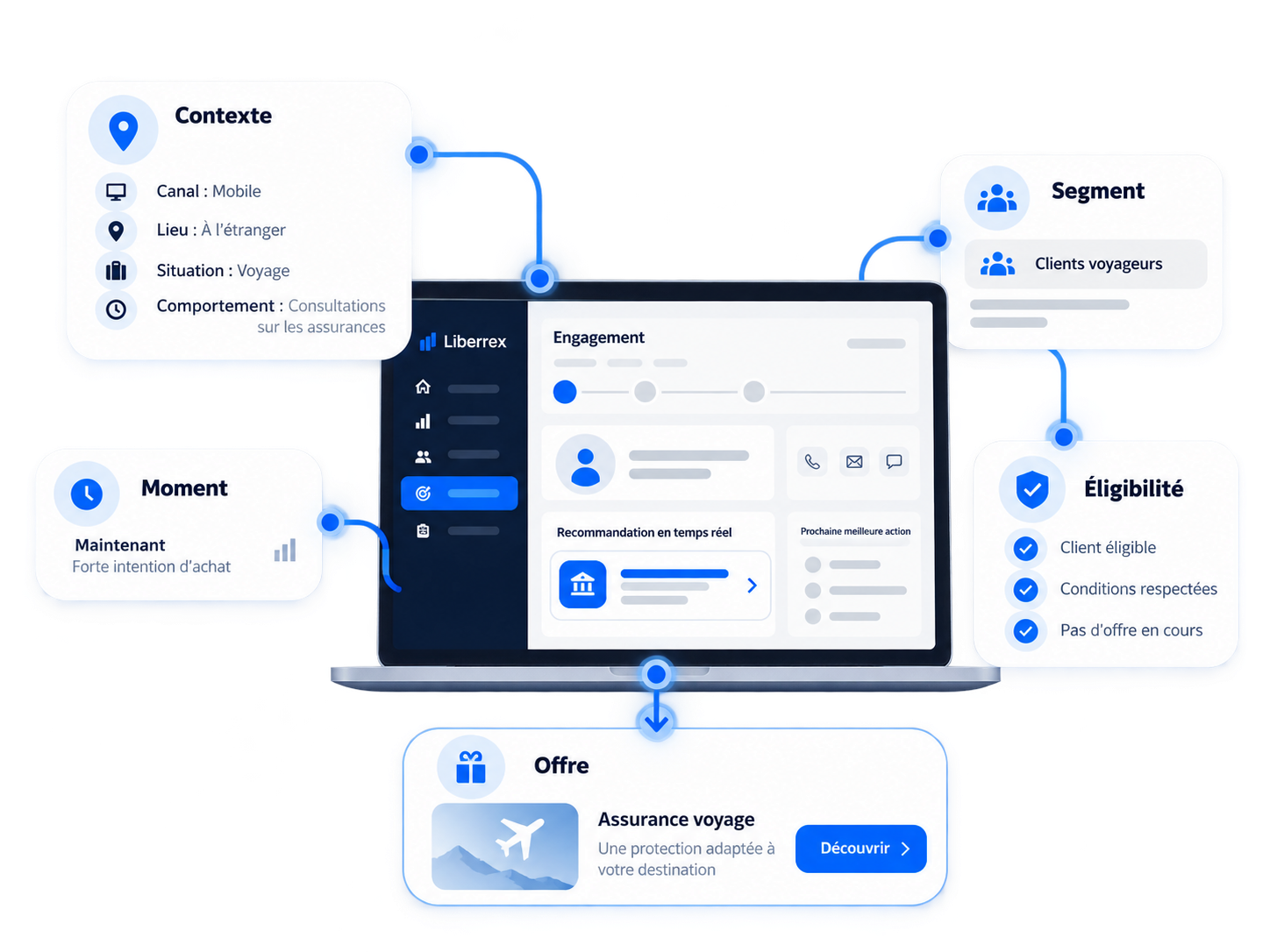
Content
Adapt the message or the information shown.
Offer
Select a relevant product or offer when the context supports it.
Moment
Adapt the interaction to the lifecycle or to a recent event.
Lifecycle
Adapt engagement to the moment in the relationship.
These are moments in the relationship, not a separate stage-management product.
Welcome
Help the customer complete the first steps.
Activation
Encourage the first meaningful use.
Adoption
Bring forward a useful service that is still unused.
Cross-sell
Present a relevant adjacent product when the context supports it.
Re-engagement
Reconnect with a customer who has become inactive.
Retention
Respond to a signal of disengagement.
Response and learning
Understand what happened after the interaction.
Follow the available response so the next interaction can be more relevant.
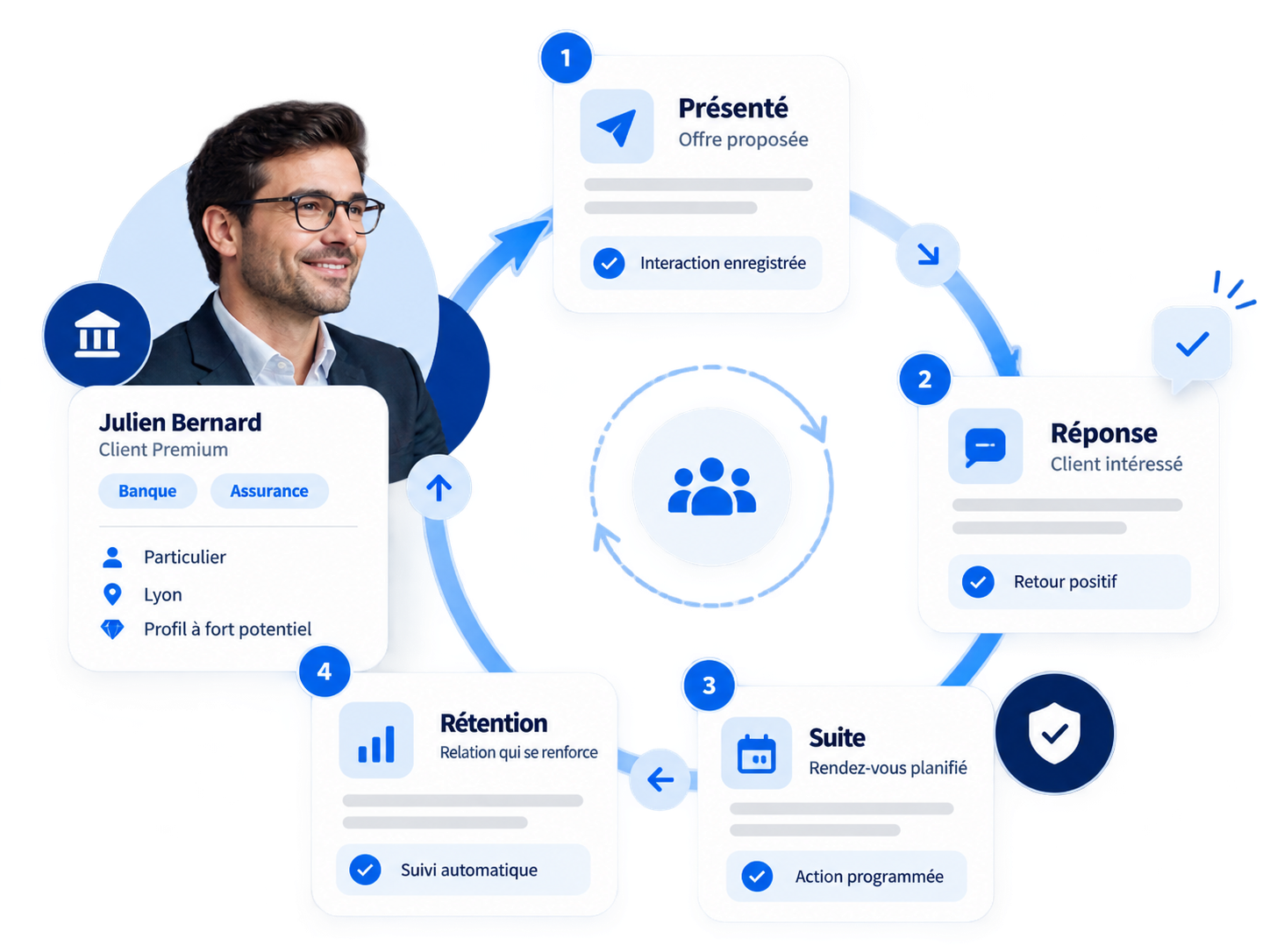
Presented
The interaction that was shown to the customer.
Response
What the customer did with that interaction, when that response is available.
What follows
The next interaction can use that response.
Use cases
Interactions for banks, insurers and digital financial services.
These situations fit a bank, an insurer, a telecom operator or a digital wallet.
Card or account activation
Encourage the customer to finish activation or a first use.
Insurance renewal
Adapt the interaction ahead of a renewal.
Wallet activation
Encourage a first transaction or a first use of the service.
Re-engagement
Reconnect with a customer whose activity has stopped.
Impact
Make each interaction more relevant.
Contextualize better
Adapt the interaction to what is known about the customer at that moment.
Personalize better
Present content or an action that fits the context.
Engage better
Favor useful interactions over generic ones.
Learn better
Use the available response to improve what comes next.
Questions
Questions about Customer Engagement
What is Liberrex Customer Engagement?
Customer Engagement decides which interaction is relevant for this customer, in this context, at this moment. It listens to signals, reads the available context, adapts the interaction and presents it. Marketing Automation builds the journey. Customer Experience runs the service flow.
How is Customer Engagement different from Marketing Automation?
Marketing Automation builds campaigns and journeys over time. Customer Engagement chooses the interaction that fits the moment in the relationship. One orchestrates the sequence. The other decides what is relevant to present.
How does Liberrex personalize an interaction?
It combines the available profile, signals, lifecycle moment and business rules to determine the content, the offer or the action to present. Personalization is part of Customer Engagement.
Which data can contextualize an interaction?
The interaction can use the profile, the segment, recent behavior, the moment in the lifecycle, prior interactions and eligibility when those inputs are configured. Customer Engagement uses that context. It does not rebuild the customer profile on its own.
How does engagement change across the lifecycle?
The interaction can differ for welcome, activation, adoption, a relevant adjacent offer, re-engagement or retention. These are moments in the relationship. They are not managed as a separate lifecycle product.
Can a recommendation from Customer & Sales Intelligence be used in an interaction?
Yes, when that signal is part of the configured context. Intelligence identifies the opportunity or the recommendation. Customer Engagement uses it to adapt the interaction that is presented.
How do you see the response to an interaction?
Follow the interaction that was presented and the response that is available, so the next interaction can take it into account.
How does Customer Engagement work with Loyalty & Gamification?
Customer Engagement adapts the interaction. Loyalty and gamification can extend that engagement with progression for the customer, when the use case calls for it. Sales challenges for teams stay in Workforce Experience.
See how Liberrex can make each customer interaction more relevant.
Use context, signals and the lifecycle to adapt engagement at the right moment.