
Customer Intelligence & Engagement
Turn customer data into commercial opportunities and decisions.
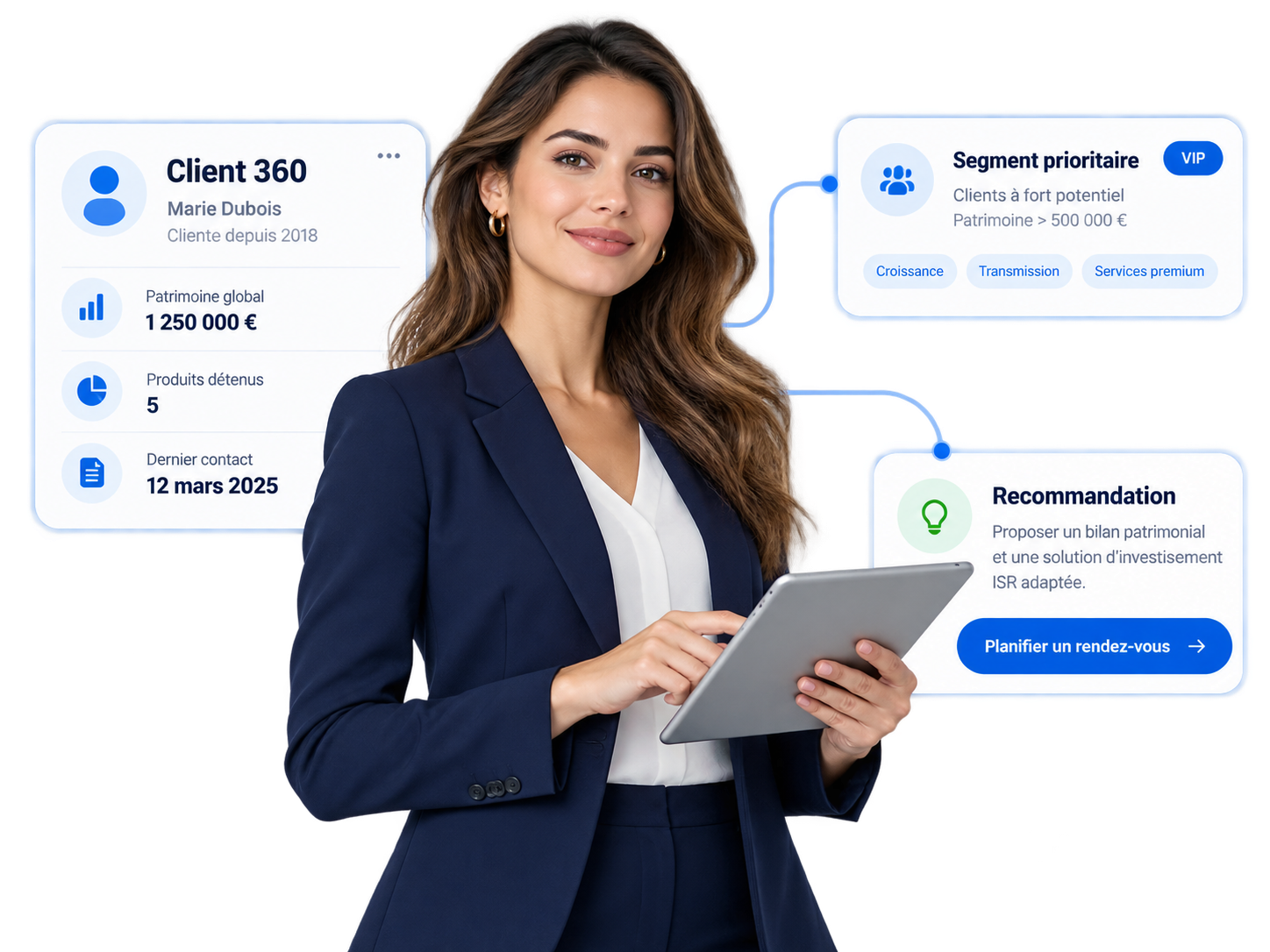
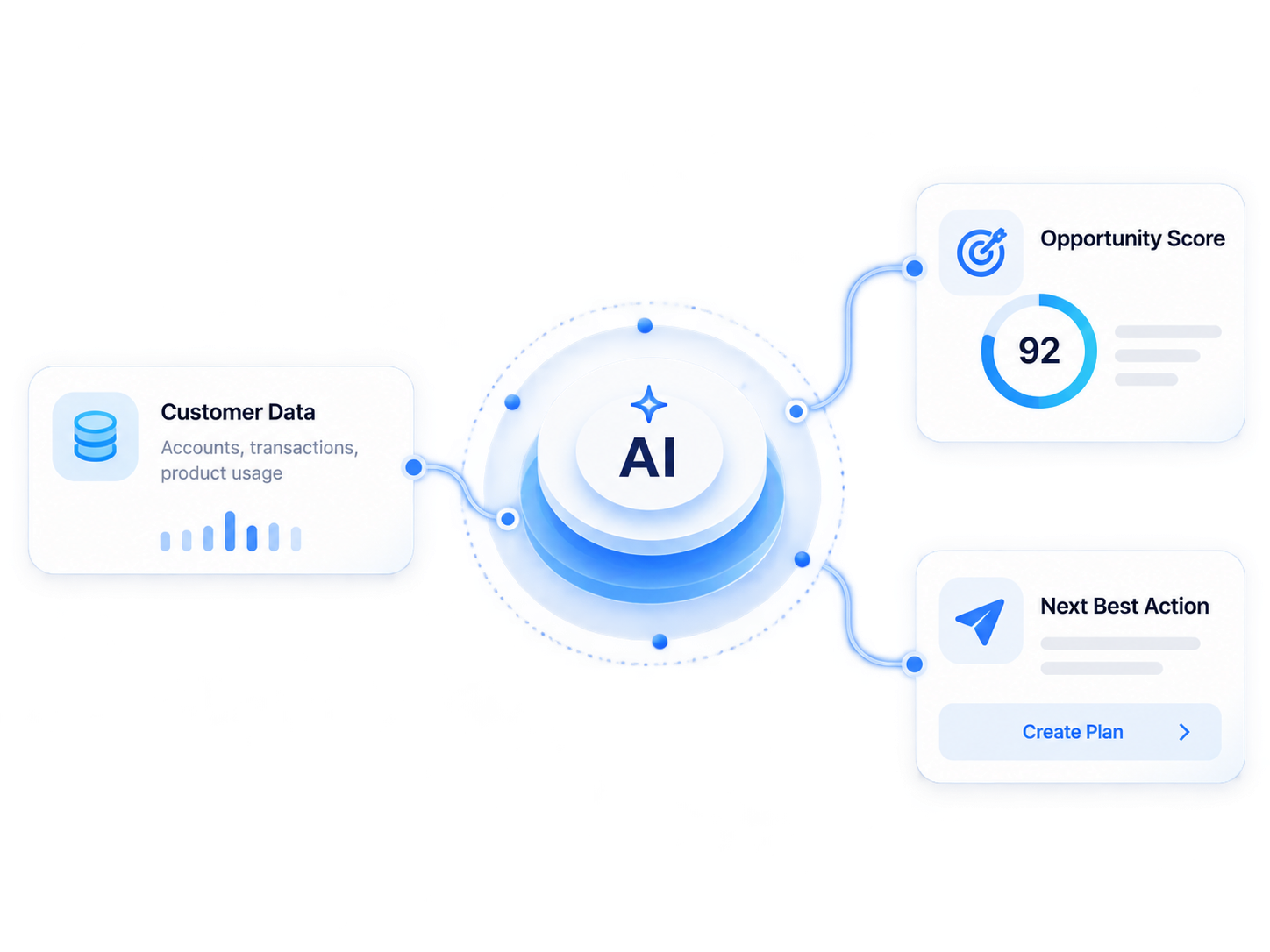
Bring together customer context, segmentation, scores and signals to detect relevant opportunities and help teams prioritize action.
From signal to action
Turn customer signals into commercial decisions.
- 01
Understand
Bring together the context that is useful around the customer.
- 02
Detect
Identify opportunities, needs, risks or relevant moments.
- 03
Prioritize
Apply rules, scores and context to decide what deserves attention.
- 04
Act
Make the recommendation or opportunity available to the commercial team.
Customer intelligence
Understand the customer in context.
A useful commercial reading of the customer. Sales Intelligence does not replace the CRM.
Customer 360
Bring together the information that matters for the commercial context.
Segmentation
Group customers by criteria teams can act on.
Scores and signals
Surface indicators that help understanding and prioritization.
Opportunities
See where commercial action can create value.
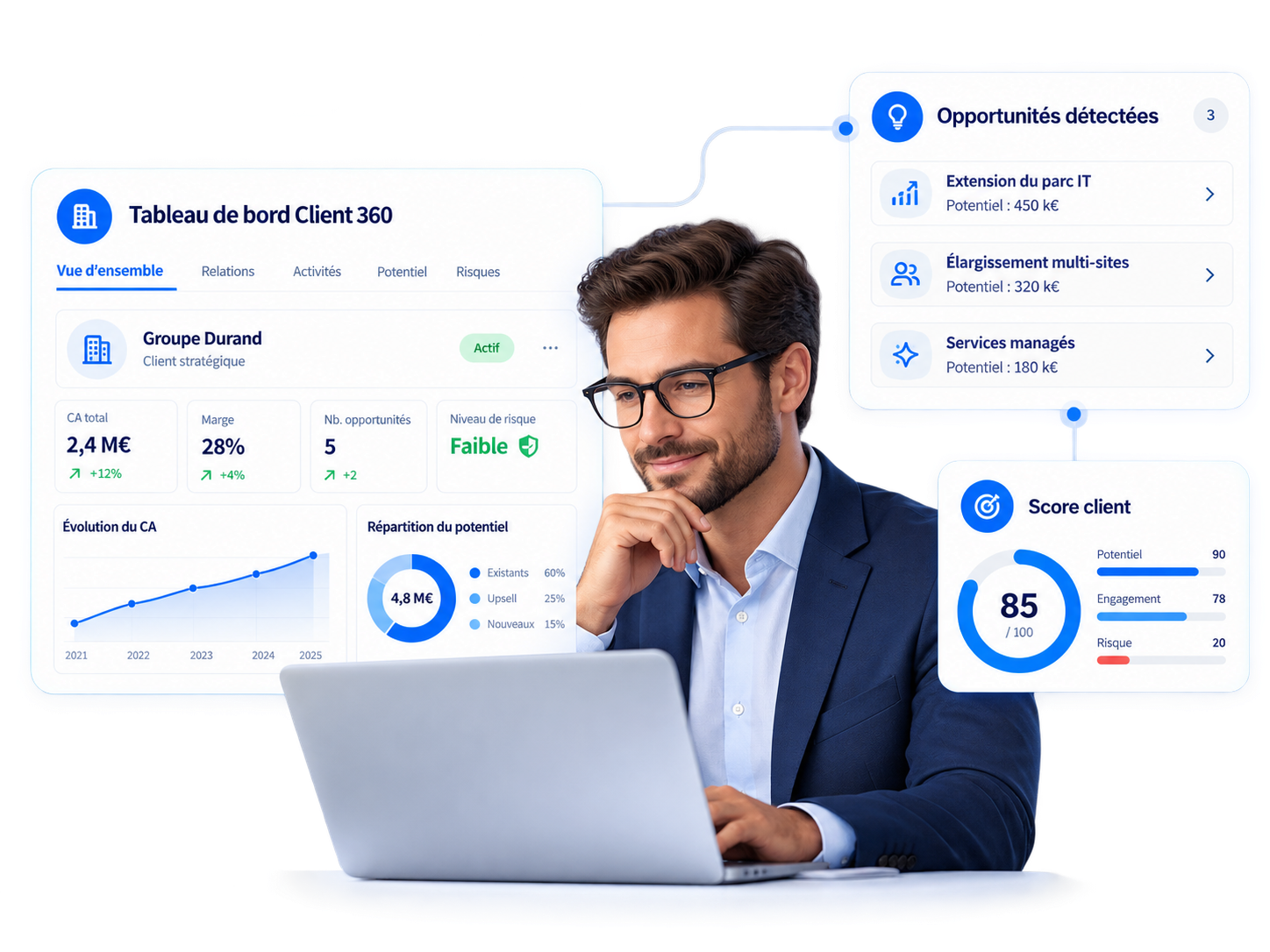
An opportunity connects a customer, a signal and a commercial potential.
Customer
Who is involved?
Signal
What changed or was detected?
Opportunity
What commercial potential appears?
Priority
How much weight should it have?
Action
What can the employee consider?
Decisioning
Prioritize the right action for the context.
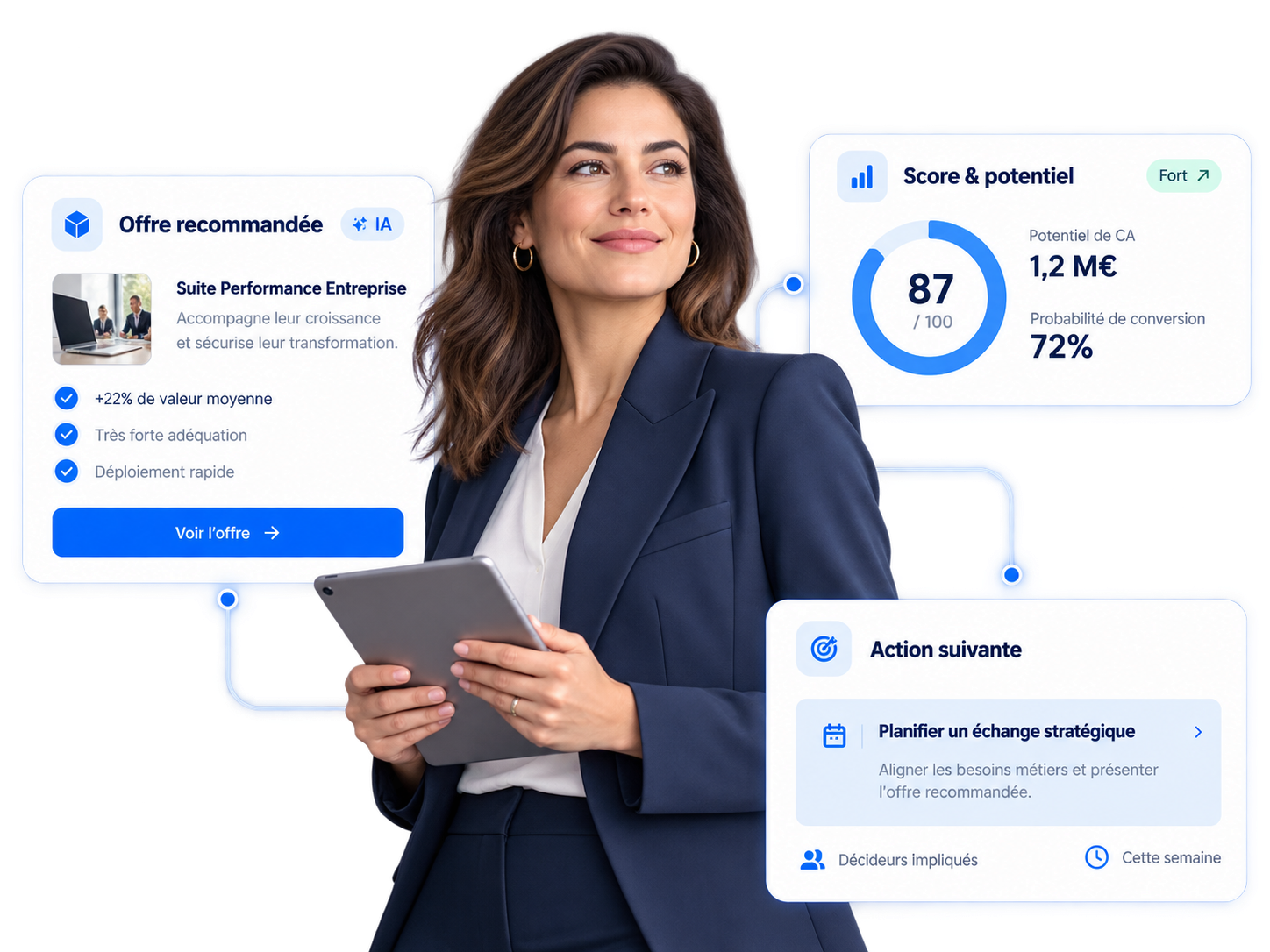
Combine business rules, eligibility, scores and context to decide which opportunities or recommendations should be presented first.
- 01
Eligibility and rules
Determine what can legitimately be proposed.
EligibilityBusiness rulesConstraints
- 02
Scoring and prioritization
Rank opportunities with a rule-based, calculated or configured model score.
ScoringPrioritization
- 03
Arbitration and recommendation
Choose among the relevant possibilities.
Next Best ActionNext Best Product
- 04
Explainability
Show the employee the main elements behind the recommendation.
SignalRuleScoreContext
Advisor workspace
Put intelligence where the action is decided.
What the employee sees, and what they can do with it.
Opportunity and priority
See what deserves attention.
Customer context
Understand why the opportunity exists.
Recommended action
See the action or offer being proposed.
Follow-up
Move to the next step when the workflow supports it.
Use cases
From commercial data to action.
Cross-sell and upsell
Identify a relevant opportunity with an existing customer.
Retention
Detect a signal that calls for attention or a loyalty action.
Product eligibility
Identify offers compatible with the rules and the customer context.
Prioritization
Help teams focus on the opportunities that are most relevant.
Operating relevance
Where the commercial decision happens with the customer.
Banking
Cross-sellCustomer equipmentRetention
Insurance
RenewalProtectionRetention
Telecommunications
UpgradeRetentionAdditional offer
Data and integrations
Work with the data the enterprise already has.
Liberrex does not replace systems of record. Sales Intelligence uses the data and signals available to enrich the commercial decision.
CRMCore bankingCore insuranceCustomer experience data
Intelligence identifies. Sales Enablement equips.
Sales Enablement
Explains the product, the arguments and the useful content.
Sales Performance & Engagement
Structures campaigns, objectives and network performance.
AI & Agents
Can enrich selected treatments or interactions when it is relevant.
Commercial impact
Make data more useful at the moment of selling.
Prioritize better
Focus attention on the opportunities that are most relevant.
Strengthen relevance
Adapt the action to the customer context and the business rules.
Reduce complexity
Bring several signals together in one usable view.
Improve steering
Give a clearer reading of opportunities, recommendations and actions.
Questions
Questions about Sales Intelligence
What is Liberrex Sales Intelligence?
Customer and sales intelligence brings together customer context, segmentation, scores and signals so opportunities become visible and teams can prioritize action. It answers which customer, which opportunity, which product or action, and which priority. The advisor workspace makes that decision readable at the moment of action. It is not a CRM, not marketing automation, and not sales enablement. The result depends on the data and rules configured for the organization.
How is Sales Intelligence different from Sales Enablement?
Sales Intelligence answers which customer, which opportunity, which product or action to consider, and which priority. Sales Enablement answers what the offer means, how to present it, which argument to use and which document to share. One identifies and prioritizes. The other prepares the commercial conversation. The two stay distinct.
How does Liberrex detect a commercial opportunity?
An opportunity links a customer, a signal and a commercial potential. The signal can be a change in situation, an eligibility condition, inactivity or a need visible in the available context. Liberrex does not guarantee a conversion. It makes the signal readable so a team can decide whether it deserves an action.
What is a Next Best Action?
A Next Best Action is the most relevant action to consider in a given context. It can come from business rules, eligibility, a score or a model, depending on the configuration. It is not necessarily produced by an AI model. It indicates an action priority, not a guaranteed result.
How are recommendations prioritized?
Prioritization combines customer context, applicable rules, eligibility and the indicators that are available. Several opportunities can exist at the same time. Arbitration keeps what deserves attention, within the limits and exclusions defined by the organization. The employee sees an ordered recommendation, with the context needed to understand it.
Can business rules be used without an AI model?
Yes. A commercial decision can rest on rules, eligibility conditions and calculated scores, without a predictive model. A model can complement that logic when it is configured. AI is not the definition of Sales Intelligence. It remains a shared capability, used only where it adds a useful criterion.
Which systems can Sales Intelligence integrate with?
Liberrex uses data the enterprise already holds. Depending on the deployment, that can include the CRM, core banking or core insurance, billing, customer activity, customer-service systems, and customer-experience data such as appointments or queues. Liberrex does not replace those systems of record.
Can recommendations be used in a branch or a contact center?
Yes, when the employee journey is configured for it. The advisor workspace brings customer context, the opportunity and the suggested action to the moment of decision, in a branch as in a contact center. What is shown depends on the scope deployed for the organization.
See how Liberrex can turn your customer data into commercial opportunities.
Connect customer context, opportunities and decisions so teams focus attention where it matters.